How This Course Works
- Register for the course on this page.
- Study the lessons online, in the order the Curriculum tab lists them. You can study on any device, at any time.
- Practice with the course's unlimited practice exam.
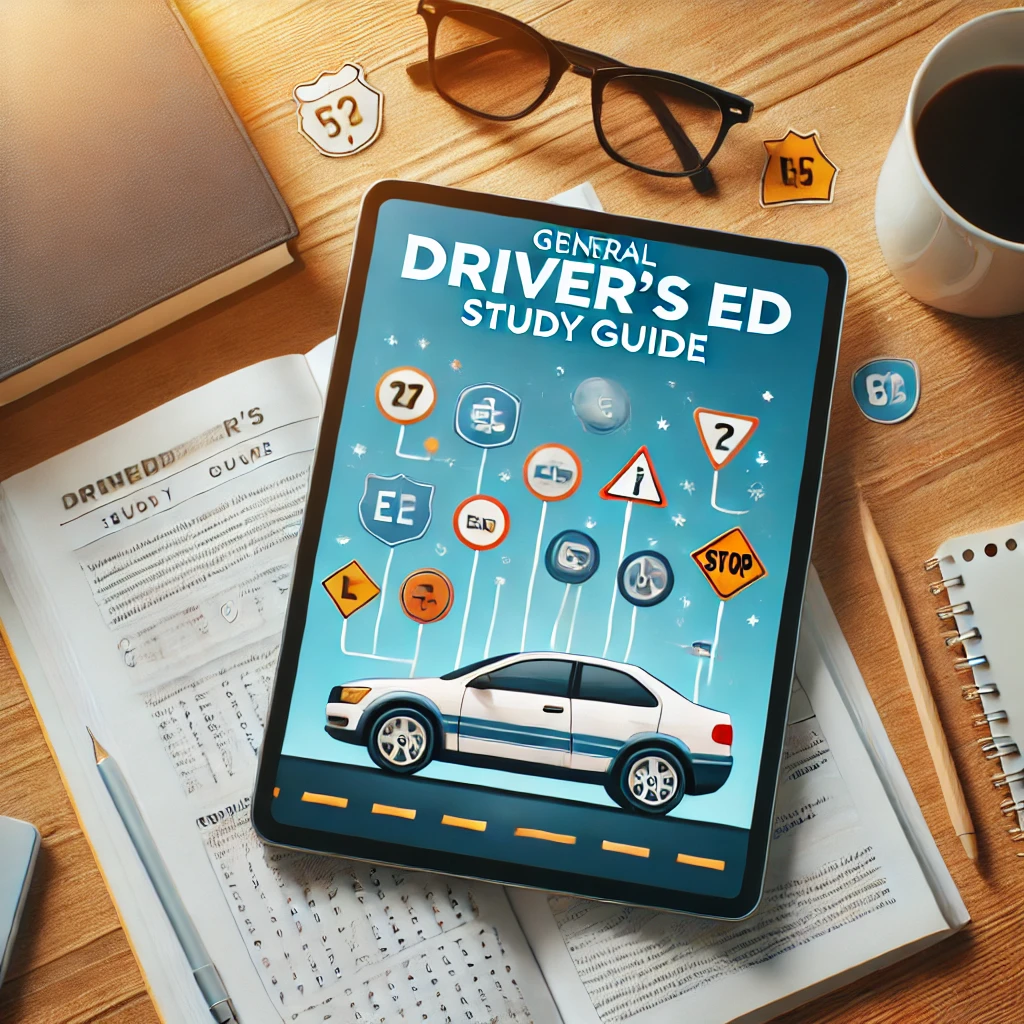
Get Drivers Ed Study Guide: 100% online and flexible, with video content and unlimited test attempts.
Study Guide To Help With Your Written Test.
Unlimited Test Attempts.
Complete On Any Device.
Audible Read Along Included.
Automatically Saved Progress.
100% online, on your own time!
7 days a week customer service.
High-Quality Drivers Ed Training at a Low Cost
Interactive and Easy-to-Follow Drivers Ed Study Lessons
 Top Test TipsKey guidance to help you pass with confidence.
 Clear Visuals of Signs and RulesEasy-to-understand visuals for signs, signals, and road rules.
 Essential Topic CoverageConcise, complete review of everything on the test.
$8.99$14.99
 Video Content
 Flexibility on any device at any time
 100% Online
 Unlimited Practice Free Exam
You can get a refund if you ask within 3 days of purchase and haven't opened the course yet (no certificate issued and no enrollment submitted to any organization). To ask, email support@getdriversed.com.
Every permit test checks the same core skill: can you read the road and react correctly? This drivers ed study guide breaks that skill into topics you can learn step by step.
Questions on impaired driving show up on nearly every knowledge test. Learn how alcohol slows reaction time and clouds judgment, why only time can sober a person up, and that drivers under the legal drinking age face zero-tolerance rules. Most states also have implied consent laws: refusing a chemical test brings its own penalties.
You also share the road with people who are harder to see. Give cyclists plenty of room when passing, stop for pedestrians in crosswalks and stay out of a truck's blind spots. If you cannot see the driver in the truck's mirror, the driver cannot see you.
Do these rules differ from state to state? The basics are very similar, but details such as alcohol limits for young drivers and permit restrictions vary, so check the driver handbook from your state's driver licensing agency.
How do I know I am ready? When you can explain why an answer is right instead of just recognizing it, you are ready to take the knowledge test at your state's driver licensing agency.
Traffic lights look simple until a question asks about a flashing light or an arrow. As you prepare, build your own signal chart: list steady red, steady yellow, flashing red, flashing yellow and the green arrow, and next to each one write what your state's driver manual says it requires. Then quiz yourself on the chart until you can answer without looking.
A few safe habits hold whatever the light shows. Approach every intersection ready to stop, and never speed up to beat a changing light. Even with a green light or arrow, look for pedestrians and for anyone running the light before you go. Check the manual too for what to do when an officer is directing traffic at a signal.
Drowsy driving is easy to underestimate. A tired driver reacts more slowly, misses signs and can drift out of the lane without noticing. Warning signs include heavy eyelids, frequent yawning, missing an exit or not remembering the last stretch of road. Coffee and an open window do not cure fatigue; only sleep does, so rest before a long drive and stop when these signs appear.
Distraction works the same way. Anything that takes your eyes off the road, your hands off the wheel or your mind off driving raises the risk of a crash. Study both topics together, and for each one learn the warning signs as well as the safe response.
Parking questions trip up many new drivers because the details are hard to picture. As you prepare, look up the hill-parking steps in your state's driver manual and learn the idea behind them: the wheels are turned so the car would roll away from traffic, not into it, if the brakes failed. Picture each case, facing downhill, facing uphill with a curb and facing uphill with no curb, and ask which way that idea points the front wheels. Then check your answer against the manual, and make setting the parking brake part of every stop on a slope.
Before backing up, turn and look behind the vehicle instead of relying only on mirrors or a camera, and move slowly. Small children and low objects can sit below the view from the rear window.
If any of these sound like you, this exam prep is a must!
