Get Up To 50% Off •Ends in
00
:
00
:
00

Telehandler Training Study Guide

4.8 (1,720 reviews on Google)Reviews on Google
20 Lessons
Certificate Included
100% Money Back Guaranteed
Graphic of person driving car representing Telehandler Training Study Guide

Get Drivers Ed Telehandler Training Study Guide: 100% online and flexible, with video content and unlimited test attempts.

  • Study Guide To Help With Your Certification.

  • Unlimited Test Attempts.

  • Complete On Any Device.

  • Audible Read-Along for enhanced learning.

  • Automatically Saved Progress.

  • 100% online, on your own time!

  • Customer service available 7 days a week.

  • Interactive and Easy-to-Follow Lessons

  • Money-back guarantee: a full refund if you ask within three days of purchase and have not started the course.

Reviews on Google

4.8out of 5

1,720 reviews · as of Nov 25, 2026

  • Certificate iconCertificateInstant Certificate Upon Course Completion
  • OSHA Compliant iconOSHA CompliantOSHA, ANSI, & CSA Compliant
  • Flexible iconFlexibleTake on your PC, mobile, or tablet — Anywhere, anytime
40% Off . Limited Time Offer

$8.99$14.99

Video ContentVideo Content

Flexibility on any device at any timeFlexibility on any device at any time

100% Online, On Your Own Time!100% Online, On Your Own Time!

Unlimited Practice Free ExamUnlimited Practice Free Exam

100% Money Back Guaranteed

What You'll Learn in This Course

The course is organized in these parts:

  • Telehandler Study Guide Introduction
  • Module 1: Accountability and Training
  • Module 2: Understanding Telehandlers
  • Module 3: Machine Components and Maintenance
  • Module 4: Safe Operations and Stability
  • Module 5: Communication and Worksite Awareness

How This Course Works

  • Register for the course on this page.
  • Study the lessons online, in the order the Curriculum tab lists them. You can study on any device, at any time.
  • Practice with the course's unlimited practice exam.

Telehandler Stability and the Load Chart

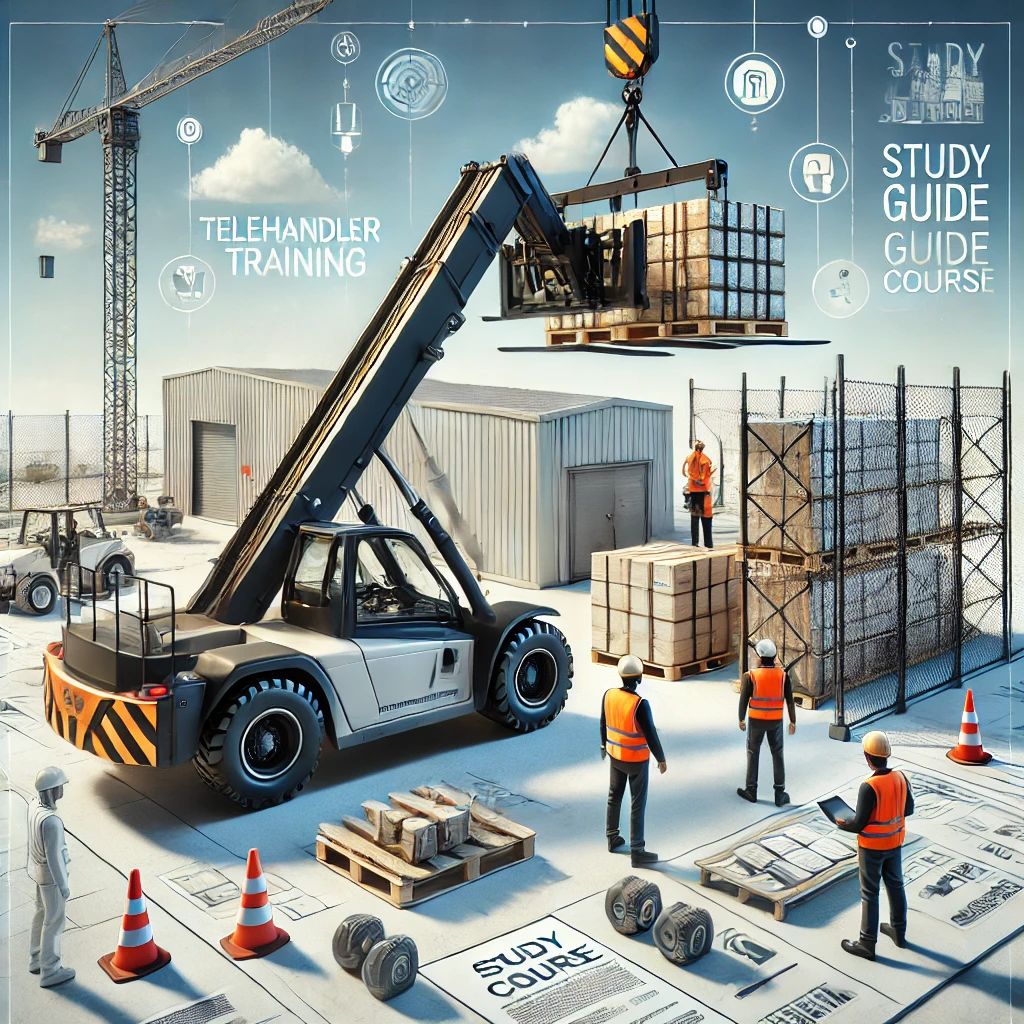
A telehandler can lift and reach like a crane while driving like a rough-terrain forklift, which makes stability the central topic of this study guide. The machine stays upright only while the combined center of gravity of machine and load stays inside its stability triangle.

  • Raising or extending the boom moves the center of gravity forward and lowers the capacity, so always read the load chart for the actual boom angle and extension.
  • Level the frame before lifting and lower the outriggers or stabilizers where the machine has them.
  • Travel with the load low and the boom retracted, and never turn sharply on a slope.

Pre-Use Inspection, Site Hazards and PPE

Each shift should begin with a walk-around: tires, hydraulic hoses and cylinders for leaks, forks or attachment pins, lights, horn, backup alarm, seat belt and the load chart itself, which must be readable. Report defects and tag the machine out rather than running it.

On site, watch for overhead power lines, soft ground, trenches, other workers and blind spots behind the load. Use a spotter when the view is blocked and agree on hand signals first. Wear the PPE your site requires, such as a hard hat, high-visibility vest and safety boots, and keep the seat belt fastened.

What should you do if the machine starts to tip? Stay in the seat, hold on, brace your feet and lean away from the fall. Jumping out is how many operators are crushed.

Study Tips for the Telehandler Test

  • Sketch the stability triangle and mark how a raised, extended load shifts the balance point.
  • Practice reading a sample load chart until you can find the capacity for any boom position.
  • Learn the attachment rule: use only attachments the manufacturer lists for that model, each with its own chart.
  • Expect your training to include a hands-on evaluation on the machine you will run, alongside the theory.

Who Is Responsible for What on a Telehandler Job

As you prepare, keep one point clear: safe telehandler work is shared. Knowing each role helps you think through who acts when something goes wrong, instead of guessing.

  • Your employer decides who is trained and allowed to run each machine, and provides the equipment, attachments and instructions for the job.
  • The operator checks the machine, follows the load chart and stops any lift that looks wrong, then tells a supervisor.
  • The spotter or signal person watches what the operator cannot see and gives clear, agreed signals.
  • Everyone nearby stays out from under a raised load and clear of the machine's path.

Steering Modes, Frame Leveling and the Controls

As you get to know telehandlers, watch for features you will not find on a standard warehouse forklift.

  • Steering modes. Many telehandlers can steer with the front wheels only, with all four wheels for tight turns, or in crab mode to move sideways. Check which mode is selected before moving, because the same turn of the wheel behaves very differently in each.
  • Frame leveling. Some models let you tilt the frame side to side to level the machine on uneven ground before raising the boom.
  • Boom and attachment controls. A single joystick often handles lift, extend and tilt. Learn each function slowly with the boom low before combining them.
  • Daily maintenance points. Fluid levels, filters and grease points keep the machine reliable; follow the schedule your employer and the manual set.

Placing Loads at Height Alongside a Crew

Give extra care to the moment a load reaches its landing spot. Agree in advance on who receives the load and exactly where it will sit. Bring the load in slowly and level, stop just short of the landing, then ease it into place. Workers on the receiving side keep their hands and bodies clear until the load is resting where it belongs, and nobody stands below it while it moves. If radio contact or eye contact breaks, stop until it is restored.

Who’s This For?

Looking for quick-reference flashcards to simplify telehandler safety training? We’ve got you covered!
Feeling unprepared after your telehandler course? Boost your confidence with our exam prep.
Need a focused, easy-to-digest summary of key telehandler operation and safety rules? Stay on track and retain what matters most.

Graphic of person pointing to board representing Telehandler Training Study Guide

Frequently Asked Questions